I landed at Salt Lake City International on a Thursday in November, rented a car I wasn't sure I needed, and spent the first day doing exactly what every other tourist does: Temple Square, the beehive building, a quick walk through downtown. By Friday afternoon I was bored. The ski resorts were still a month out, the snow hadn't come yet, and I had four days left. So I started driving without much of a plan, which is how I ended up finding the parts of this city that actually feel lived in.
Most people come to Salt Lake for the skiing or to visit relatives. They hit the obvious landmarks, eat lunch somewhere on Main Street, and leave. I get it. The city has done a decent job making sure the tourist stuff is easy to find. But there's a whole other Salt Lake underneath all that—quieter, stranger, more interesting. It took me pushing into neighborhoods where my phone's GPS seemed less sure of itself, but that's where things got good.
Red Butte Garden and the Backstory Nobody Knows
Red Butte Garden sits on the University of Utah's eastern edge, and yeah, it's technically known. But I'd guess fewer than one in ten visitors to Salt Lake actually make it there. I drove up on a Saturday morning expecting maybe a weekend crowd doing the standard garden walk. Instead I had entire sections mostly to myself.
The garden itself is beautiful—native plants, water features, thoughtfully laid paths. But what grabbed me was the story. The butte itself is this massive red rock formation that rises right out of the campus. You can hike up from the garden parking area in about twenty minutes and get a view of the valley that I honestly hadn't expected from anywhere in the city. No crowds, no viewpoint infrastructure, just you and the Salt Lake Valley spreading out below. The hike's easy enough, not one of those things where you feel like you're risking your life. On a clear day you can see all the way to the Oquirrh Mountains.
I spent a couple hours there, did the hike twice because the afternoon light was different the second time. The garden has an entrance fee if you want to go through the whole thing, but the hiking access is separate and much cheaper.
The Marmalade Historic District Doesn't Feel Like Downtown
This neighborhood is maybe two miles northwest of Temple Square, but it might as well be a different city. Marmalade is the name everyone uses now, even though it's also called the Avenues area depending on which local you ask. It's where the older residential buildings are, the ones that don't fit anywhere else's aesthetic.
I wandered through here on a Sunday morning when most people were either at church or sleeping in. Victorian houses, early twentieth-century cottages, yards with actual trees that looked like they'd been growing for decades. There's a coffee place on one of the main streets—I won't name it because I want to actually remember it the way it was, quiet and not Instagram-famous. Some local galleries tucked into converted houses. A bookstore that specialized in Utah-related stuff but wasn't some tourist trap.
What makes it work is that it doesn't feel designed for visitors. There's no clear "attraction" here, no viewpoint with a sign. Just a neighborhood where people actually live, with businesses that serve locals first and tourists as an afterthought. I bought a used copy of something about Utah mining history from the 1970s from a woman who seemed happy to talk about it for an hour while exactly zero other customers came in. That interaction alone was worth the drive.
This Viewpoint North of the City Actually Has Perspective
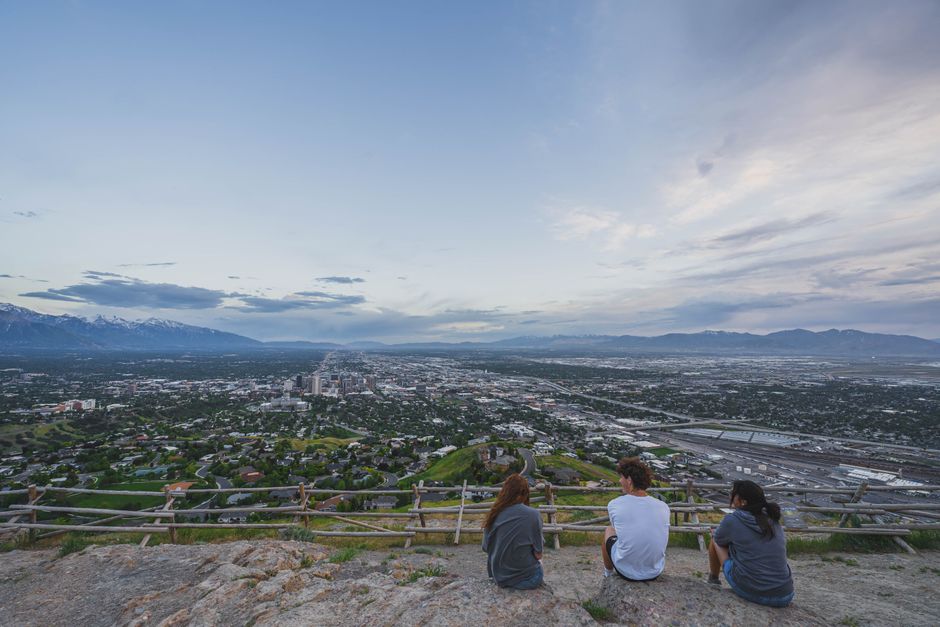
I found this spot kind of by accident, following a road that looked promising on the map and turning off when I saw a small pullout. It's on the north side of the valley, looking back south toward downtown and the Wasatch range. Most tourists never even know it exists because it's not on the main circuit and there's no sign at ground level saying you should stop here.
What's useful about this viewpoint—and I won't be too specific about the exact location because part of its charm is that you actually have to look for it—is that you get the geography of the city all at once. You see how the sprawl extends, where the mountains actually start, what parts are developed and what aren't. It's the kind of view that makes a place make sense in a way that being down at street level doesn't.
I spent maybe forty minutes there, took some photos that didn't look like anything special on my phone but felt important while I was taking them. A couple other cars came and went. A guy with a dog. That was it. No crowds, no gift shop, no parking fee. Just a good vantage point and quiet.

The Museum of Natural History Isn't the Church, and That's Why You Should Go
The Natural History Museum is also at the University of Utah, but it's a completely different experience from Red Butte. This is a legitimate small museum that doesn't try to be something it's not. You can probably do it in an hour if you're moving, or two hours if you're actually reading the displays.
The exhibits are solid—Utah dinosaurs, geology, Native history. But what made it worthwhile for me was the complete absence of other people. On a Friday afternoon I had whole rooms to myself. The staff seemed genuinely pleased when I asked questions, not like they were going through a script. There's a focus on actual scientific work happening in Utah, not just a history of the state treated like a museum artifact. The building itself is modest, which somehow makes it better than if it were in some grand space downtown.
Admission is reasonable. I spent more time there than I expected to, which I think is the highest compliment you can give a museum—you went in without a lot of expectations and ended up actually invested in what you were seeing.
Liberty Park and the Neighborhood That Remembers Salt Lake's Working Days
Liberty Park is a few blocks east of downtown, in a part of the city that still feels like it has actual roots. This isn't a manicured park. It's a green space in a neighborhood, used by the people who live there. I sat on a bench for a while on a Tuesday afternoon and watched kids play, older folks walk through. Somebody was practicing music in one of the nearby houses—saxophone, I think, badly but with commitment.
The surrounding neighborhood is worth walking through too. You see buildings that were clearly something else fifty years ago. A community center that looks like it's actually used. Small grocery stores and restaurants that serve the people in the neighborhood, not the tourist circuit. I ate lunch at a place that didn't have online reviews, didn't seem to want any, made good food in a kitchen you could almost see from the dining area.
There's a reason tourists don't end up here—it's not on the way to anything else, it's not spectacularly scenic, and there's nothing marketed as a "must-see." But that's exactly why it's worth going. You get a sense of what the city actually is when you're not in the parts it's dressed up for visitors.

The Parts of Salt Lake That Reveal Themselves Slowly
After a few days of this, wandering and doubling back and spending time in places that didn't feel like tourist destinations, I realized that's kind of the whole story of Salt Lake City. It's not a place that hits you over the head with greatness. It doesn't have the dramatic entry that a mountain town does or the immediate walkability of some older cities. But if you give it time and don't try to squeeze every major attraction into a couple days, there's actually something there.
The sketchy parts of my first day—the feeling that I'd done everything worth doing by noon—got replaced by something more interesting: the sense that I was just beginning to understand the basic shape of the place. That's not always comfortable. Some of my favorite neighborhoods were genuinely ugly by conventional standards. Some of the best views were from places you could drive right past without noticing.
Salt Lake rewards slowness. It's patient. If you treat it like a to-do list, you'll finish in a day and wonder why anyone lives here. If you treat it like a place where people actually live—which it is—and you're willing to spend time figuring out why, you'll find things worth finding. That's not a tourist hack or a secret formula. It's just what you get when you spend time anywhere with genuine curiosity.